
Octane rating tells you how resistant gasoline is to engine knock. It does not measure how much energy the fuel contains, how clean it is, or whether it will automatically make every engine produce more power. A higher number simply means the fuel can tolerate more demanding combustion conditions before uncontrolled autoignition becomes a problem.
Pars Behin lab provides petroleum product testing and quality control services for fuels and hydrocarbon materials. For refineries, traders, importers, exporters, and fuel buyers, accurate octane rating measurement is important because gasoline must meet the specification required for its market and intended engine application. Pars Behin lab also provides laboratory services for gasoline, diesel, and other petroleum products.
Understanding octane rating explained properly also requires one important distinction: the number printed on a pump is not calculated the same way everywhere. A 95 octane label in one country may use Research Octane Number, while an 87 octane label in the United States normally refers to the average of Research and Motor Octane Numbers.
What Is Octane Rating?
What is Octane Rating? It is a measure of the resistance of a spark ignition fuel to knock.
Knock occurs when part of the fuel and air mixture autoignites abnormally instead of burning through the intended flame front initiated by the spark plug. Severe or persistent knock can reduce performance and may damage an engine.
The U.S. Energy Information Administration describes octane rating as a measure of fuel stability and notes that higher octane fuel is more resistant to spontaneous combustion under pressure.
“The higher an octane number, the more stable the fuel.”
So, what does octane rating mean in practical terms? It tells an engine designer or vehicle owner how much resistance the fuel has to knock under standardized testing conditions.
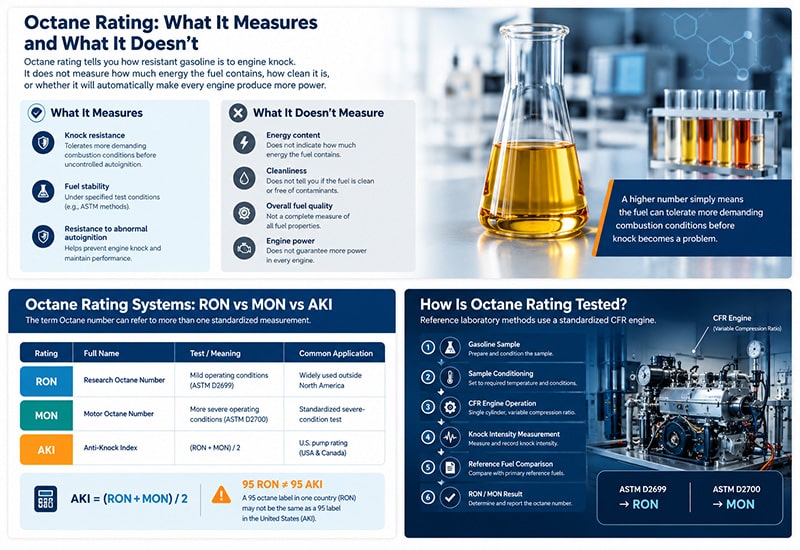
Octane Number, RON, MON and AKI
The term Octane number can refer to more than one standardized measurement.
Research Octane Number, or RON, is determined according to ASTM D2699. The method uses a standardized single-cylinder, variable compression ratio CFR engine and compares the knock intensity of the sample with primary reference fuels. ASTM states that RON correlates with antiknock performance under relatively mild operating conditions.
Motor Octane Number, or MON, is determined using ASTM D2700. It uses the same basic reference concept but under more severe operating conditions. ASTM states that MON correlates with antiknock performance under severe operating conditions.
In the United States, the pump value is normally the Anti-Knock Index:
AKI = (RON + MON) / 2
The Federal Trade Commission requires U.S. gasoline pump labels to display the minimum octane rating using the (R+M)/2 method.
| Octane measure | What it represents | Common use |
|---|---|---|
| RON | Research Octane Number | Widely displayed at pumps outside North America |
| MON | Motor Octane Number | More severe standardized engine test |
| AKI | Average of RON and MON | Pump rating in the United States and Canada |
| Octane number | General term | May mean RON, MON or AKI depending on context |
This is why an Octane rating of petrol shown as 95 in a RON based market should not be directly compared with an American 95 AKI label.
Octane Rating of Gasoline and Petrol
The Octane rating of gasoline depends on the fuel formulation and the rating system used.
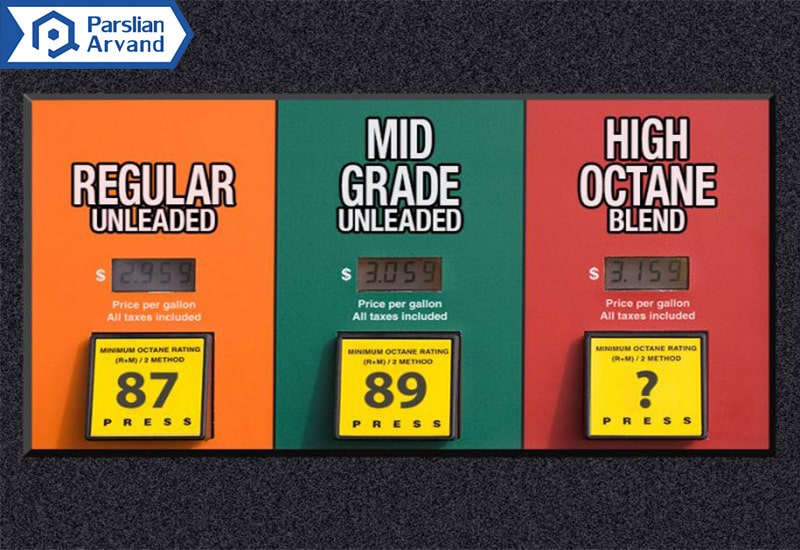
- In the United States, EIA identifies regular gasoline as generally 87 AKI, midgrade as around 89 to 90, and premium as roughly 91 to 94.
- In countries where RON is displayed, motorists commonly see values such as 91, 92, 95, 98, or 100.
The Octane rating of petrol and the Octane rating of gasoline therefore refer to the same fundamental anti-knock property, but the label cannot be interpreted correctly until you know whether it is RON, MON, or AKI.
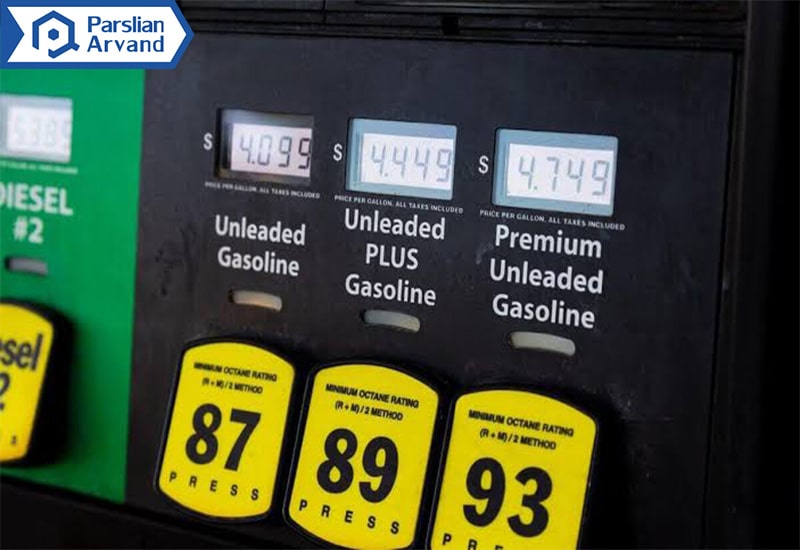
87 vs 89 vs 93 Octane
The common U.S. comparison 87 vs 89 vs 93 octane usually refers to AKI values.
In general:
- 87 is regular gasoline
- 89 is commonly midgrade
- 91 to 94 is typically premium
The difference between 87 vs 89 vs 93 octane is knock resistance, not a guarantee of higher energy content.
If a vehicle is designed for 87, filling it with 93 usually provides little or no benefit. The U.S. Department of Energy notes that vehicles engineered for regular gasoline are unlikely to gain much from premium fuel. Vehicles that require premium should use it.
What Is Octane 92 and 95?
What is octane 92 and 95? In many markets these numbers refer to RON.
A 95 RON fuel has greater standardized knock resistance than a 92 RON fuel. That does not mean 95 contains proportionally more energy or will improve every vehicle.
When considering What is octane 92 and 95?, the correct choice comes from the vehicle manufacturer’s minimum or recommended rating.
Using lower octane than required can cause the engine management system to retard ignition timing in modern vehicles, potentially reducing performance. Using higher octane than the engine can exploit may simply increase fuel cost.
Which Is Better, 95 or 98 Octane?
Which is better, 95 or 98 octane? Neither is universally better.
98 RON has greater knock resistance. That can matter in an engine with a high compression ratio, turbocharging, aggressive ignition timing, or calibration designed to exploit premium fuel.
But if the vehicle is designed for 95 RON and gains nothing from higher octane, 98 may offer no meaningful advantage.
The answer to Which is better, 95 or 98 octane? is therefore vehicle specific. Follow the manufacturer’s requirement rather than assuming the highest number must be the best fuel.
Is 100 Octane Better Than 95?
Is 100 octane better than 95? In terms of knock resistance, yes. In terms of practical benefit for every engine, no.
Higher octane can enable engine technologies such as increased compression ratio and turbocharging to operate more efficiently when the engine is designed or calibrated to take advantage of that fuel. Department of Energy research has linked higher octane capability with the potential for increased compression ratio and improved engine efficiency.
However, Is 100 octane better than 95? for a normal road car that requires only 95? Not necessarily. The engine may not be able to make useful changes in boost, timing, or compression to exploit the additional knock resistance.
High Octane Fuel Benefits
The main high octane fuel benefits are linked to knock resistance.
In appropriately designed engines, higher octane can support:
- Higher compression ratios
- More aggressive ignition timing
- Greater turbocharger boost
- Reduced tendency toward knock under high load
- Improved efficiency or performance in engines calibrated for the fuel
DOE research notes that high octane fuels can enable higher compression ratios and more efficient engine operation.
The important qualification is that high octane fuel benefits depend on engine design. Premium gasoline is not automatically an upgrade for every car.
Ethanol Octane Rating
The Ethanol octane rating is relatively high compared with conventional gasoline, which is one reason ethanol is useful as a gasoline blending component.
The U.S. Alternative Fuels Data Center states that ethanol has a higher octane number than gasoline and can improve the octane quality of gasoline blends.
DOE fuel property data lists neat ethanol with a very high pump octane value relative to conventional gasoline.
However, a high Ethanol octane rating does not mean ethanol contains more energy. Ethanol contains less energy per gallon than gasoline. Octane resistance and energy density are separate properties.
Can You Mix 91 and 95 Petrol?
Can you mix 91 and 95 petrol? In general, compatible grades of gasoline can physically be mixed, and the resulting octane will normally fall somewhere between the two original grades.
The exact final octane rating depends on the volumes, fuel compositions, and blending behavior. Octane blending is not always perfectly linear for every component.
For example, mixing equal amounts of compatible 91 RON and 95 RON petrol would normally be expected to produce a fuel with an octane level in that general range, but it should not be treated as a laboratory certified 93 RON fuel without testing.
The more important answer to Can you mix 91 and 95 petrol? is whether the final blend still satisfies the vehicle’s minimum requirement. Mixing should not be used to justify running an engine on a lower rating than its manufacturer specifies.
Octane Rating of Diesel
The phrase Octane rating of diesel is technically misleading. Diesel engines rely on compression ignition rather than spark ignition, so diesel ignition quality is normally described using cetane number or cetane index.
Octane measures resistance to autoignition, which is desirable in gasoline engines. Diesel fuel needs suitable readiness to autoignite after injection.
For that reason, an Octane rating of diesel is not the normal quality specification used to select diesel fuel. Cetane measurements provide the relevant ignition quality information.
This difference also explains why gasoline and diesel rating numbers cannot be directly compared.
How to Test Octane Rating?
How to Test Octane Rating? The reference laboratory methods use a standardized CFR engine.
ASTM D2699 determines RON by operating the test fuel in a single-cylinder, four stroke, variable compression ratio CFR engine and comparing its knock intensity with primary reference fuel blends. ASTM D2700 uses a related standardized engine procedure to determine MON under more severe conditions.
A simplified process is:
- Prepare and condition the gasoline sample.
- Operate the CFR engine under the specified method conditions.
- Measure the knock intensity.
- Compare the sample with reference fuel blends.
- Determine the matching Octane number.
- Report RON or MON according to the method used.
So, How to Test Octane Rating? correctly cannot be answered with a simple handheld field reading when a reference ASTM result is required. The method, instrument, test conditions, and reporting basis all matter.
Octane Testing and Parsbehin Lab
Parsbehin Lab provides laboratory quality control services for petroleum products including gasoline and other refined fuels. Its published petroleum laboratory services cover fuel testing, composition analysis, product grade confirmation, density, distillation, sulfur, and other petroleum properties.
Where a specific octane rating test is required, the client should confirm the requested RON, MON, or other specification, the relevant method, sample requirements, and the laboratory’s current accredited scope before testing.
Frequently Asked Questions about octane rating
What is Octane Rating?
What is Octane Rating? It is a measure of a gasoline's resistance to engine knock. Higher octane means greater resistance to abnormal autoignition under standardized test conditions.
What does octane rating mean?
If you are asking what does octane rating mean, it describes antiknock performance rather than fuel energy content. A higher number does not automatically mean better fuel economy.
What is the difference between RON and MON?
RON is determined under ASTM D2699 conditions, while MON is measured under the more severe operating conditions of ASTM D2700.
Which is better, 95 or 98 octane?
98 has greater knock resistance, but the useful choice depends on the engine. If the manufacturer specifies 95 and the engine cannot exploit 98, the higher grade may provide little practical benefit.
Is 100 octane better than 95?
100 octane provides higher knock resistance, but it is not automatically more useful in an engine designed for 95.
Can you mix 91 and 95 petrol?
Generally yes, provided both fuels are otherwise compatible and suitable for the vehicle. The resulting rating should lie between the two, but the precise number is formulation dependent.
What is octane 92 and 95?
They usually refer to different RON grades in markets that display Research Octane Number. 95 provides higher knock resistance than 92.
Is octane used to rate diesel?
No. Although the search phrase Octane rating of diesel is sometimes used, diesel ignition quality is normally characterized by cetane number or cetane index.