

Gasoline looks like a simple fuel at the pump, but chemically it is anything but simple. It is a carefully blended mixture of volatile hydrocarbons produced from crude oil and other petroleum streams, then adjusted to meet requirements for octane, volatility, distillation behavior, sulfur content, emissions performance, and seasonal conditions.
Pars Behin lab provides laboratory testing and quality control services for petroleum products, including fuels and hydrocarbon materials. For refineries, traders, importers, exporters, and industrial buyers, understanding gasoline composition and the gasoline production process is important because a fuel can look perfectly normal while failing one or more critical specifications. Pars Behin lab states that it began operating in 2007 as a partner laboratory of the Standard Organization in Iran.
So, What is gasoline? It is not one chemical and it does not come straight from a crude oil distillation tower ready for use. Modern gasoline is assembled from several refinery streams and, depending on the market, may also contain ethanol and performance additives. Gasoline explained in practical terms is therefore a carefully engineered fuel whose final properties depend on both refinery processing and controlled blending.
What Is Gasoline?
Gasoline is a volatile petroleum fuel formulated primarily for spark ignition internal combustion engines. The U.S. Energy Information Administration defines it as a fuel made from crude oil and other petroleum liquids. Refineries and blending facilities produce the finished motor fuel that reaches retail stations.
A useful way to understand gasoline is to think of it as a formulation rather than a single refinery fraction. Individual components are selected because they contribute different characteristics, including octane, volatility, density, combustion behavior, and emissions performance.
The Agency for Toxic Substances and Disease Registry describes automotive gasoline as a mixture containing straight and branched alkanes, cycloalkanes, olefins, and aromatic hydrocarbons such as benzene, toluene, and xylenes.
“Gasoline is a fuel made from crude oil and other petroleum liquids.”
Source: U.S. Energy Information Administration.
What Is Gasoline Made Of?
When asking what is gasoline made of, it is important to distinguish chemical composition from refinery blending components.
From a chemical perspective, gasoline composition generally includes several families of hydrocarbons rather than one dominant compound.
| Component group | Examples or characteristics | Role in finished gasoline |
|---|---|---|
| Paraffins | Straight chain alkanes | Contribute to the hydrocarbon base and volatility profile |
| Isoparaffins | Branched alkanes | Often provide better octane performance than comparable straight chain molecules |
| Olefins | Unsaturated hydrocarbons | Commonly associated with cracking streams |
| Naphthenes | Saturated cyclic hydrocarbons | Natural components of petroleum derived streams |
| Aromatics | Toluene, xylenes and controlled amounts of benzene | Can contribute to octane but are subject to fuel quality and environmental controls |
| Oxygenates | Ethanol and certain ethers where permitted | Used as blending components in some fuel markets |
| Additives | Detergents, corrosion inhibitors and antioxidants | Used in small amounts for specific performance purposes |
ATSDR notes that gasoline additives can influence both physical properties and the toxicity of individual formulations.
What Are the Main Ingredients of Gasoline?
What are the main ingredients of gasoline? In refinery language, finished gasoline is usually made from a combination of blending streams rather than a fixed chemical recipe.
Typical components may include:
- Straight run gasoline or naphtha
- Reformate
- Fluid catalytic cracking gasoline
- Alkylate
- Isomerate
- Butane in permitted amounts
- Ethanol or another approved oxygenate
- Small quantities of fuel additives
The exact proportions are not universal. EIA explains that gasoline characteristics depend on the crude oil used, refinery configuration, other blending ingredients, location, and season.
This is why the answer to What are the main ingredients of gasoline? changes from one refinery and market to another.
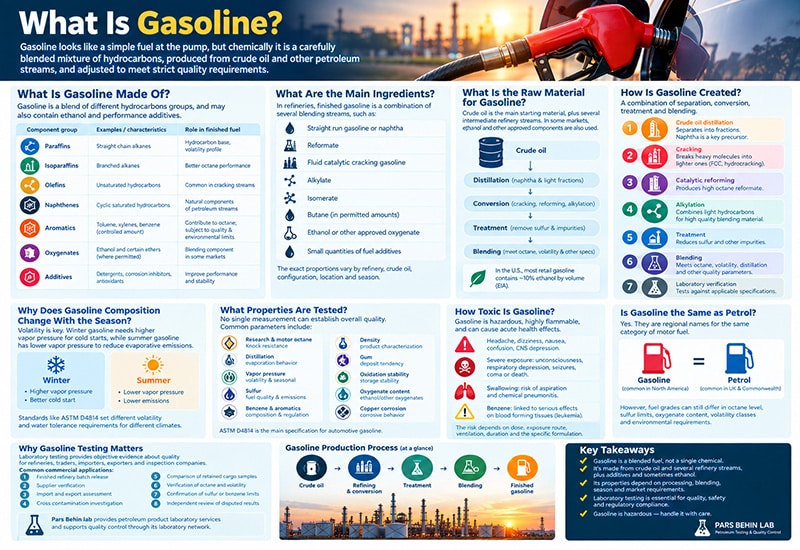
What Is the Raw Material for Gasoline?
What is the raw material for gasoline? Crude oil is the principal traditional starting material, but the actual gasoline production process uses several intermediate refinery streams.
Crude oil first passes through distillation, which separates hydrocarbons according to boiling range. Naphtha and lighter fractions can contribute directly or be upgraded in other units. Heavier fractions can also be converted into gasoline range molecules.
Modern blending facilities may additionally use ethanol and other approved components. In the United States, EIA reports that most retail motor gasoline contains approximately 10 percent ethanol by volume, although this is a U.S. market characteristic rather than a worldwide rule.
So, when What is the raw material for gasoline? is asked in a technical context, the answer is primarily crude petroleum plus processed refinery streams and, where applicable, non petroleum blending components.
How Is Gasoline Created?
How is gasoline created? The process is a combination of separation, molecular conversion, treatment, and blending.
A simplified gasoline production process follows these steps:
1. Crude oil distillation
Crude oil is heated and separated into fractions. Naphtha is one important gasoline precursor.
2. Cracking
Heavy hydrocarbons are broken into lighter molecules. Fluid catalytic cracking and hydrocracking can produce streams suitable for gasoline blending.
3. Catalytic reforming
Lower octane naphtha is chemically rearranged to produce higher octane reformate.
4. Alkylation
Selected light hydrocarbons produced during cracking are combined to form alkylate, a useful gasoline blending component.
5. Treatment
Refinery streams may be treated to reduce sulfur and other undesirable constituents.
6. Blending
Multiple streams are combined to achieve the required octane, vapor pressure, distillation characteristics, and other quality parameters.
7. Laboratory verification
The finished batch is tested before release against the applicable specification.
EIA confirms that cracking converts heavier fractions into lighter products, reforming produces high octane gasoline components, and alkylation combines light cracking products to form gasoline blending material.
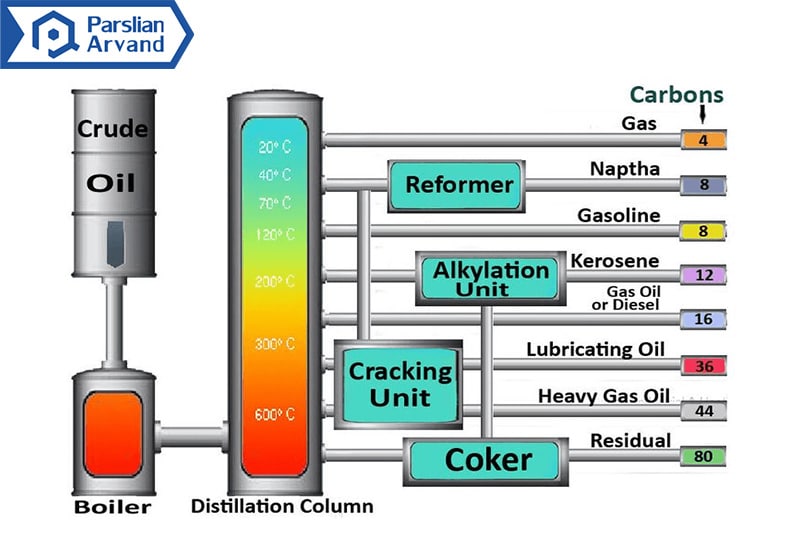
How Gasoline Is Refined Without a Single “Gasoline Unit”
Understanding how gasoline is refined requires one important correction: refineries generally do not operate a single machine that turns crude oil directly into finished gasoline.
Instead, different units contribute different blending components. Distillation provides initial fractions. Cracking increases the supply of lighter hydrocarbons. Reforming raises octane. Alkylation creates valuable high quality blending material. Treatment improves selected properties.
Only after those streams have been produced does the refinery decide how to combine them.
As EIA explains, technicians blend multiple refinery streams according to octane level, vapor pressure, and other requirements.
This blending stage is central to how gasoline is refined, because meeting one property can affect another. A formulation with adequate octane may still need adjustment for volatility, sulfur, benzene, or seasonal performance.
Why Gasoline Composition Changes With the Season
Gasoline is not necessarily formulated the same way throughout the year.
Volatility is particularly important. A fuel must evaporate sufficiently for cold starting, but excessive volatility in hot weather increases evaporative emissions and can cause operational problems.
EIA reports that winter gasoline generally requires higher vapor pressure, while summer gasoline is formulated with lower vapor pressure. U.S. summer fuel rules therefore restrict Reid vapor pressure in many regions.
ASTM D4814, the specification for automotive spark ignition engine fuel, also recognizes different volatility and water tolerance requirements according to climatic conditions.
This seasonal variation is another reason no single gasoline composition can represent every commercial gasoline.
Which Properties Are Tested in Gasoline?
A professional gasoline analysis may involve several methods because no individual measurement can establish overall quality.
Typical parameters include:
| Property | Why it matters |
|---|---|
| Research and motor octane | Resistance to engine knock |
| Distillation | Evaporation behavior across the boiling range |
| Vapor pressure | Volatility and seasonal performance |
| Sulfur | Fuel quality and emissions requirements |
| Benzene and aromatics | Composition and regulatory control |
| Density | Product characterization and quantity calculations |
| Gum | Deposit forming tendency |
| Oxidation stability | Resistance to deterioration during storage |
| Oxygenate content | Verification of ethanol or other oxygen containing components |
| Copper corrosion | Screening for corrosive behavior |
ASTM lists D4814 as the principal specification for automotive spark ignition engine fuel and identifies methods for octane, density, distillation, benzene, sulfur, gum, and hydrocarbon type among the commonly applied gasoline standards.
Laboratory testing is therefore an essential part of the gasoline production process, not simply a final administrative check.
How Toxic Is Gasoline to Humans?
How toxic is gasoline to humans? Gasoline is hazardous, highly flammable, and capable of causing acute health effects when inhaled, swallowed, or allowed to remain in prolonged contact with skin.
ATSDR reports that gasoline exposure can cause headache, dizziness, nausea, confusion, and central nervous system depression. Severe exposure may lead to unconsciousness, respiratory depression, seizures, coma, or death. Swallowing gasoline also creates a serious risk of aspiration into the lungs and chemical pneumonitis.
Gasoline also contains substances with their own toxicological significance. Benzene is one example. The U.S. EPA regulates benzene content in gasoline, and ATSDR identifies long term benzene exposure as a cause of serious effects on blood forming tissues, including leukemia.
The answer to How toxic is gasoline to humans? therefore depends on dose, exposure route, ventilation, duration, and the specific formulation. Routine fueling with appropriate precautions is very different from deliberate inhalation, ingestion, or sustained occupational exposure.
Is Gasoline the Same as Petrol?
Is gasoline the same as petrol? Yes. They are regional names for essentially the same category of motor fuel.
ATSDR lists “petrol” among the synonyms for gasoline. The word gasoline is dominant in North American English, while petrol is widely used in British and other Commonwealth English.
However, Is gasoline the same as petrol? should not be confused with asking whether every grade is identical. Different countries may specify different octane levels, sulfur limits, oxygenate contents, volatility classes, and environmental requirements.
Why Gasoline Testing Matters for Commercial Quality Control
Gasoline can be visually clear and still be outside specification. Laboratory testing gives refineries, traders, importers, exporters, and inspection companies objective evidence about its quality.
Typical commercial applications include:
- Finished refinery batch release
- Supplier verification
- Import and export assessment
- Investigation of cross contamination
- Comparison of retained cargo samples
- Verification of octane and volatility
- Confirmation of sulfur or benzene limits
- Independent review of disputed results
Pars Behin lab provides petroleum product laboratory services and states that it supports quality control activities through its laboratory network. Clients requiring gasoline analysis should confirm the requested method, specification, sample quantity, current laboratory scope, and reporting requirements before submitting a sample.
Frequently Asked Questions about Gasoline
What is gasoline?
Gasoline is a volatile petroleum fuel consisting of many hydrocarbons and approved blending components. It is used mainly in spark ignition engines.
What is gasoline made of?
When asking what is gasoline made of, the answer includes paraffins, isoparaffins, olefins, naphthenes, aromatics, and, in some markets, oxygenates such as ethanol and small quantities of additives.
What are the main ingredients of gasoline?
The main refinery blending components can include straight run gasoline, reformate, cracked gasoline, alkylate, isomerate, butane, and approved oxygenates.
What is the raw material for gasoline?
Crude oil is the primary traditional raw material. Refineries convert it into multiple intermediate streams that are blended into finished gasoline.
How is gasoline created?
How is gasoline created? Through crude distillation, cracking, reforming, alkylation, treatment, blending, and final quality testing.
How toxic is gasoline to humans?
Gasoline can cause neurological, respiratory, skin, and gastrointestinal effects depending on exposure. Severe inhalation or ingestion can be life threatening.
Is gasoline the same as petrol?
Yes. Gasoline and petrol are regional terms for the same general motor fuel, although individual commercial grades and specifications differ.
Why does gasoline composition vary?
Gasoline composition changes with refinery configuration, crude feedstock, octane targets, environmental rules, oxygenate use, location, and seasonal volatility requirements.