
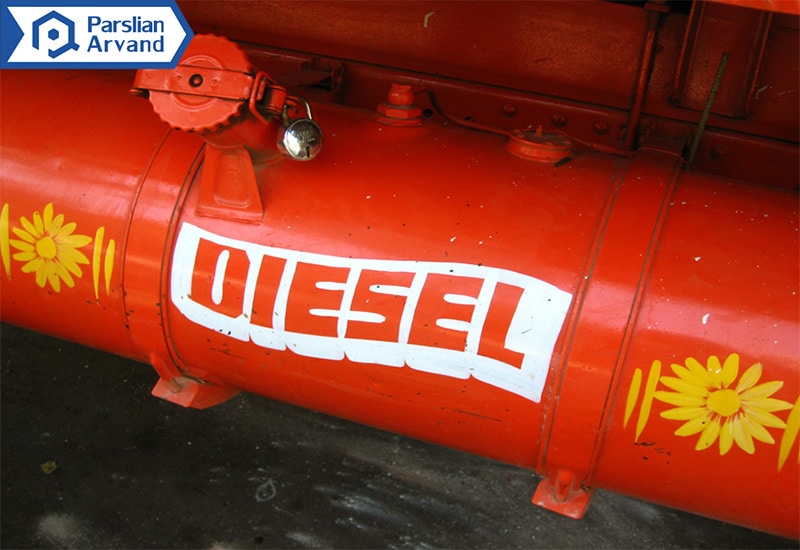
Diesel fuel is a middle distillate fuel designed primarily for compression ignition engines. Unlike gasoline engines, which use a spark plug to ignite a premixed fuel and air charge, diesel engines compress air until it becomes hot enough for injected fuel to ignite. That difference in engine operation shapes the composition, refining process, and quality requirements of the fuel.
Pars Behin Lab provides laboratory testing and quality control services for diesel fuel and other petroleum products. Its published capabilities include density, viscosity, sulfur, flash point, distillation, water, low temperature properties, and calculated cetane index. These measurements help refineries, traders, importers, exporters, and industrial users determine whether a diesel sample meets the required specification.
So, what is diesel fuel made of? Conventional petroleum diesel is primarily a mixture of hydrocarbon molecules obtained from crude oil refining, particularly middle distillate streams. Modern diesel may also contain biodiesel in permitted blends, while renewable diesel is produced from fats and oils through different processing routes but can be chemically similar to petroleum diesel.
What Is Diesel Fuel?
What is Diesel Fuel? The U.S. Energy Information Administration describes diesel fuel as the common term for distillate fuel oil sold for use in compression ignition engines. Most conventional diesel is refined from crude oil.
“Diesel fuel is the common term for distillate fuel oil.”
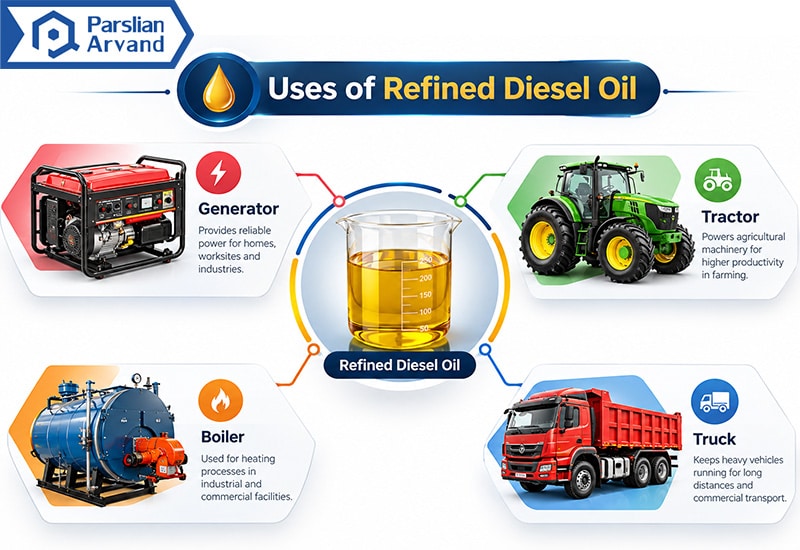
Diesel engines are used in trucks, buses, trains, construction machinery, agricultural equipment, ships, generators, and some passenger vehicles.
The term diesel fuel describes a performance category rather than one pure chemical. Like gasoline, it contains many hydrocarbons. The U.S. Department of Energy Alternative Fuels Data Center gives conventional low sulfur diesel a general hydrocarbon range of approximately C8 to C25.
What Is Diesel Fuel Made Of?
When asking what is diesel fuel made of, the simplest answer is a mixture of hydrocarbons with boiling ranges and properties suitable for compression ignition engines.
Typical diesel fuel composition includes:
- Normal and branched paraffins
- Cycloparaffins or naphthenes
- Aromatic hydrocarbons
- Small amounts of sulfur compounds, depending on the grade
- Performance additives where required
- Biodiesel components in approved blends
The precise diesel fuel composition varies with crude oil source, refinery configuration, conversion processes, hydrotreating severity, blending components, and product specification.
Diesel is generally heavier and less volatile than gasoline. EIA notes that diesel fuels have higher boiling points and specific gravity than gasoline.
Diesel Fuel Properties That Matter
The most important Diesel fuel properties are not evaluated by appearance alone. ASTM D975 identifies a range of characteristics used to control commercial diesel fuel quality. The current ASTM D975 specification covers properties such as flash point, cloud point, water and sediment, carbon residue, ash, distillation, viscosity, sulfur, cetane number, cetane index, aromaticity, lubricity, and conductivity.
| Property | What it indicates | Why it matters |
|---|---|---|
| Cetane number or index | Ignition quality | Starting and combustion behavior |
| Viscosity | Resistance to flow | Injection and fuel-system performance |
| Density | Mass per unit volume | Product identity and quantity calculations |
| Sulfur | Sulfur concentration | Emissions control and product grade |
| Flash point | Flammability characteristics | Storage and handling safety |
| Distillation | Boiling-range profile | Volatility and product consistency |
| Water and sediment | Contamination | Fuel-system reliability and storage quality |
| Cloud and pour characteristics | Low-temperature behavior | Winter operation |
| Lubricity | Ability to reduce wear | Fuel pump and injector protection |
These Diesel fuel properties interact. A sample can pass sulfur requirements while failing viscosity, cetane, water, or another specification.
How Diesel Is Produced From Crude Oil
Understanding how diesel is produced starts with crude oil distillation.
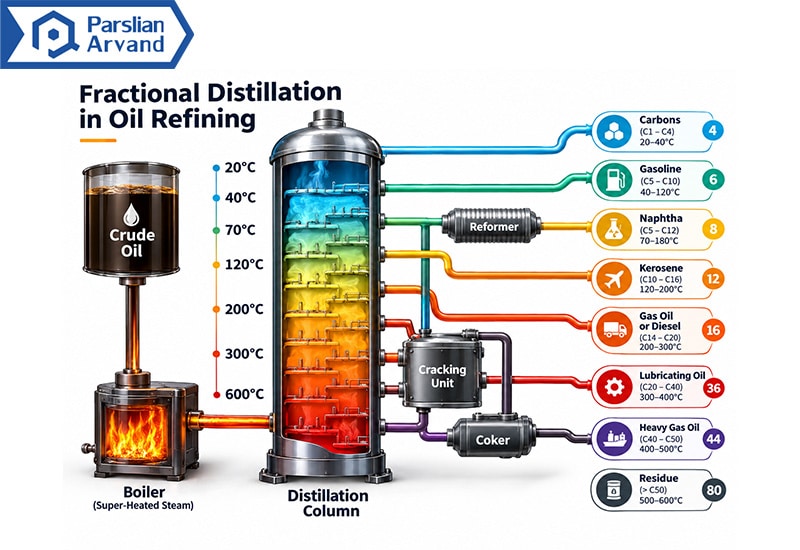
Refineries heat crude oil and separate it into fractions according to boiling range. Medium-weight liquids, including distillates, are drawn from the middle portions of the atmospheric distillation system. EIA identifies separation, conversion, and treatment as the three fundamental stages of crude oil refining.
A simplified diesel refining process includes:
1.Crude oil desalting
Water, salts, and suspended material are reduced before high temperature processing.
2.Atmospheric distillation
Crude oil is separated into gases, naphtha, kerosene, distillate streams, gas oils, and residue.
3.Conversion
Heavier gas oils may be converted into lighter products. Hydrocracking is particularly important because it converts heavy gas oil into cleaner diesel, jet fuel, and other products using hydrogen and a catalyst.
4.Hydrotreating
Distillate streams are treated with hydrogen and catalysts to reduce sulfur and improve product quality.
5.Blending
Suitable refinery streams are combined to achieve the required cetane, density, viscosity, distillation, sulfur, and cold-flow properties.
6.Laboratory testing
The finished batch is tested against the applicable diesel specification before release.
This sequence explains how diesel is produced in a modern refinery. The exact route varies with crude quality and refinery configuration.
Why the Diesel Refining Process Includes Hydrocracking
Simple distillation cannot always produce enough high quality diesel to satisfy market demand.
Heavy gas oils can be sent to a hydrocracker, where large hydrocarbon molecules are broken into smaller molecules in the presence of hydrogen and catalysts. EIA identifies hydrocracking as an important source of diesel and jet fuel.
The diesel refining process therefore combines physical separation with chemical conversion. Modern refinery diesel may contain material originating from straight run distillate streams as well as hydrocracked and other upgraded components.
Diesel Fuel Types
There are several useful ways to describe Diesel fuel types.
Petroleum Diesel
This is conventional diesel refined primarily from crude oil.
ASTM D975 currently defines several No. 1-D and No. 2-D grades differentiated partly by sulfur level, as well as No. 4-D for certain low and medium speed diesel engine applications.
No. 1 Diesel
No. 1-D is a lighter and more volatile distillate. It can be useful where lower-temperature performance is important.
No. 2 Diesel
No. 2-D is the common general-purpose middle distillate used in many road vehicles and other high-speed diesel engines.
Biodiesel
Biodiesel is not petroleum diesel. It consists of mono-alkyl esters produced from vegetable oils, animal fats, or recycled oils. Pure biodiesel is commonly called B100 and meets ASTM D6751 in the United States.
Renewable Diesel
Renewable diesel can be made from fats, oils, and greases through hydrotreating and other processes. Unlike biodiesel, it is a hydrocarbon fuel and can meet ASTM D975.
These Diesel fuel types should not be confused simply because they can all operate compression ignition engines.
Is Diesel an Unleaded Fuel?
Is diesel an unleaded fuel? The question uses terminology normally associated with gasoline.
Diesel is not generally marketed or classified as “leaded” or “unleaded.” Modern diesel specifications instead focus on parameters such as sulfur, cetane quality, viscosity, lubricity, flash point, and cold-flow performance.
The important historical distinction for modern diesel has been sulfur rather than lead. EIA notes that current U.S. on-highway diesel is ultra-low sulfur diesel, with sulfur limited to 15 ppm.
So, Is diesel an unleaded fuel? In everyday language, modern road diesel is not a leaded motor fuel, but “unleaded diesel” is not the standard technical grade designation.
What Is Diesel Fuel vs Gasoline?
What Is diesel fuel vs gasoline fundamentally about? The biggest difference is how the two fuels are intended to ignite.
Gasoline is designed for spark ignition engines and is rated primarily by octane resistance to knock. Diesel is designed for compression ignition and is characterized by cetane related ignition quality.
| Feature | Diesel fuel | Gasoline |
|---|---|---|
| Engine type | Compression ignition | Spark ignition |
| Key ignition rating | Cetane | Octane |
| General boiling range | Heavier | Lighter |
| Typical density | Higher | Lower |
| Ignition system | Compression heat | Spark plug |
| Main refinery family | Middle distillate | Lighter gasoline-range blend |
EIA confirms that diesel has higher boiling point and specific gravity than gasoline and that diesel engines ignite fuel using the high temperature of compressed air rather than spark plugs.
This is the essential answer to What Is diesel fuel vs gasoline: they are different refinery fuels engineered for different combustion systems.
Why Diesel Fuel Testing Is Necessary
Finished diesel must meet several properties simultaneously. One successful test does not demonstrate overall conformity.
Commercial testing can support:
- Refinery batch release
- Supplier qualification
- Import and export verification
- Fuel contamination investigations
- Storage quality control
- Cargo inspection
- Comparison of supplier and receiver samples
Pars Behin Lab lists diesel among the products covered by its petroleum laboratory services. Published capabilities include density, viscosity, sulfur, flash point, pour point, distillation range, water-related testing, and calculated cetane index.
For a commercial sample, the diesel grade, applicable specification, test methods, sampling history, and reporting deadline should be defined before testing begins.
Frequently Asked Questions about diesel fuel
What is Diesel Fuel?
What is Diesel Fuel? It is a distillate fuel formulated for compression ignition engines and commonly produced from crude oil refining.
What is diesel fuel made of?
It is primarily a mixture of middle-range hydrocarbons. Depending on the grade, it may also contain additives or approved biodiesel components.
What are the main Diesel fuel types?
Important Diesel fuel types include No. 1-D, No. 2-D, and certain heavier diesel grades, as well as biodiesel and renewable diesel, which are produced through different routes.
Is diesel an unleaded fuel?
The term “unleaded” is normally applied to gasoline. Diesel is classified using properties such as sulfur content and cetane quality rather than leaded versus unleaded terminology.
What Is diesel fuel vs gasoline?
Diesel is a heavier compression ignition fuel characterized by cetane quality. Gasoline is a lighter spark ignition fuel characterized by octane rating.
How is diesel produced?
Conventional diesel is produced through crude oil distillation, conversion processes such as hydrocracking, hydrotreating, blending, and final quality testing.
What determines diesel fuel quality?
Important factors include cetane quality, viscosity, density, sulfur, flash point, distillation behavior, lubricity, water, contamination, and low-temperature performance.