
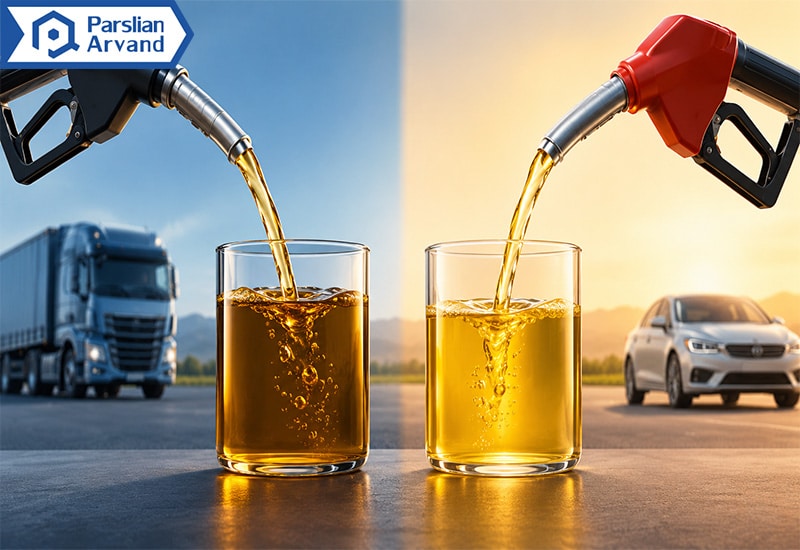
Choosing between two vehicles with diesel vs gasoline is one of the most fundamental decisions faced by car buyers, transportation industry professionals, and automotive engineers. Despite their common origin, crude oil, these two fuels have fundamental differences in chemical composition, combustion method, thermal efficiency, and operational applications that directly affect vehicle performance, maintenance costs, and environmental impacts.
At Pars Behin Lab, we are with you to conduct a scientific and precise analysis of these differences. In the following, from gas vs diesel engine and combustion mechanisms to diesel vs gasoline efficiency and the impact of emission standards such as Euro 7, an effort has been made to provide a comprehensive and up-to-date picture. If you ask which is better diesel or gas, the definitive answer depends on your driving pattern, operational needs, and economic considerations; however, a precise understanding of diesel vs gasoline density, diesel vs gasoline in car, and diesel vs gasoline truck will help you make an informed decision.
Difference of diesel vs gasoline
The starting point for understanding diesel vs gasoline is examining the molecular structure and physical properties of these two fuels. Gasoline is mainly composed of light hydrocarbons with shorter chains (approximately 4 to 12 carbon atoms), while diesel is made of longer and heavier chains (about 12 to 15 carbon atoms). This structural difference directly affects diesel vs gasoline density:
- diesel density is around 810 to 840 kg/m³
- gasoline density is reported at around 735 to 745 kg/m³.
| Property | Diesel | Gasoline |
| Density (kg/m³) | 0.810–0.840 | 0.735–0.745 |
| Flash point (°C) | > 52 | ≈ −43 |
| Autoignition temperature (°C) | ≈ 210 | 247–280 |
| Lower heating value (kJ/kg) | ≈ 42,437 | ≈ 45,609 |
An important distinction is that diesel fuel generally has a higher boiling point and specific gravity than gasoline. These physical characteristics contribute to the different handling, combustion, and energy characteristics of the two fuels.
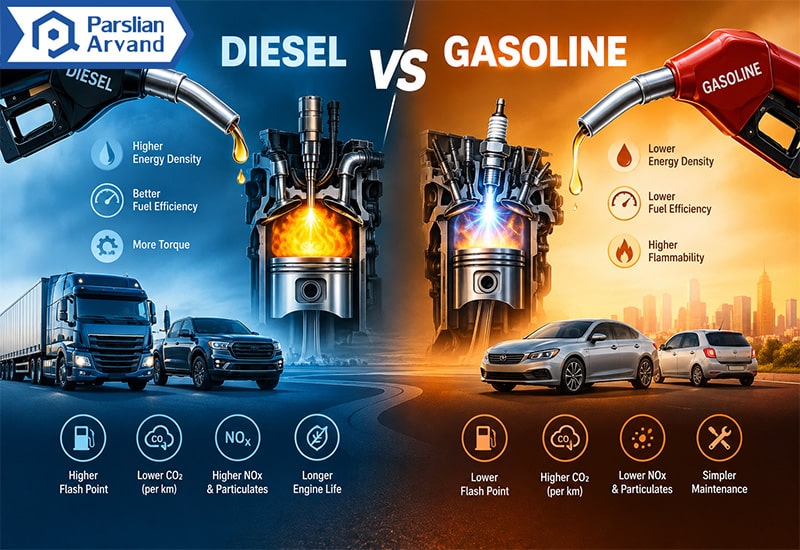
An interesting point is that diesel vs gasoline flammability shows a significant difference. Gasoline, with a flash point of about minus 43 degrees Celsius, is highly flammable, while diesel has a flash point above 52 degrees Celsius, and for this reason its storage and transportation are considered safer. However, the autoignition temperature of diesel is lower (about 210 degrees Celsius versus 247 to 280 degrees for gasoline), and this property allows diesel to ignite without the need for an external spark and solely through high compression.
Combustion Mechanism of Vehicle Fuel
In answer to gas vs diesel engine, one must point to the fundamental difference in the combustion method. A gasoline engine uses spark ignition (Spark Ignition or SI): the fuel-air mixture enters the cylinder, is compressed, and then the spark plug ignites it by creating an electric arc. In contrast, a diesel engine relies on compression ignition (Compression Ignition or CI): air is first strongly compressed and heated to a temperature above 400 degrees Celsius, then diesel is injected into the cylinder and immediately ignites.
The main combustion differences can be summarized as follows:
- Gasoline engine: uses spark ignition and a spark plug.
- Diesel engine: uses compression ignition and does not normally require a spark plug.
- Gasoline: fuel and air are mixed before or during the intake/injection process depending on the engine design.
- Diesel: air is compressed first, followed by direct injection of diesel fuel into the hot compressed air.
- Compression ratio: diesel engines generally operate with higher compression ratios than gasoline engines.
This difference in the combustion method directly affects the compression ratio:
- Gasoline engines usually have a compression ratio between 8:1 and 12:1
- diesel engines experience a compression ratio of 14:1 or higher
The reason for this limitation in gasoline engines is the phenomenon of “knock” or premature combustion, which occurs at high pressures and can cause serious damage to the engine.
From the perspective of fuel injection system pressure, the differences are also striking. Gasoline direct injection (GDI) systems usually operate at pressures of about 100 to 200 bar, while common rail diesel injection systems experience pressures between 1,500 and 2,500 bar. This higher pressure ensures better fuel atomization and more complete combustion.
diesel vs gasoline efficiency
One of the most important axes of diesel vs gasoline efficiency is thermal efficiency. Modern gasoline engines usually have thermal efficiency in the range of 30 to 36 percent, while diesel engines achieve efficiency of 42 to 44 percent. This roughly 25 percent advantage in fuel efficiency is a direct result of the higher compression ratio and more efficient combustion process in diesel engines.
In practice, this difference in diesel vs petrol efficiency appears as lower fuel consumption in diesel vehicles. For example, in comparing two versions of the same sedan, the diesel version can record about 43 miles per gallon (mpg) on the highway, while the gasoline version shows about 36 mpg. In passenger cars, this difference can lead to 15 to 20 percent savings in fuel consumption.
Another important factor is energy density. Diesel generally contains more energy per gallon than gasoline, which contributes to its strong fuel-economy characteristics.
The U.S. Energy Information Administration, for example, lists higher energy content per gallon for diesel fuel than motor gasoline.
In practical terms, the efficiency advantage of diesel can be particularly relevant when:
- The vehicle travels long distances regularly.
- Annual mileage is relatively high.
- The vehicle operates under heavy loads.
- Highway or constant-speed driving represents a significant portion of use.
- Low-rpm torque is important for the application.
In diesel vehicles, the advantage of diesel vs petrol efficiency becomes especially prominent on long trips and highway driving at constant speed, because diesel engines produce higher torque at lower rpm and operate in a more optimal range.
Applications of diesel vs gasoline in Passenger and Heavy Vehicles
The answer to diesel vs gasoline in car and diesel vs gasoline truck indicates a specific division of labor in the automotive industry. Gasoline passenger cars are mainly recommended for urban driving and short trips, because gasoline engines run more smoothly at lower rpm, have a lower initial purchase cost, and their maintenance is simpler. In contrast, diesel passenger cars are considered a more economical option for drivers who regularly cover long distances.
For passenger vehicles, the choice can generally be evaluated through these factors:
- Driving distance: frequent long-distance driving can favor diesel.
- Driving environment: gasoline can be practical for many urban and short-trip applications.
- Fuel consumption: diesel engines generally provide higher fuel efficiency.
- Initial cost: diesel vehicles may have a higher purchase price.
- Maintenance: the complexity and cost of maintenance depend on the specific engine and emission-control system.
In the field of heavy vehicles, diesel vs gasoline truck clearly favors diesel. Diesel trucks can produce much higher torque at low rpm, which is vital for towing heavy loads. A modern diesel truck can produce more than 1,000 pound-feet of torque, which is about twice the torque of a comparable gasoline truck. For this reason, most heavy trucks, buses, and heavy commercial vehicles worldwide use diesel engines.
Another important point in diesel vs gasoline truck is the longer lifespan of diesel engines. Because of their sturdier construction and lower operating speed, these engines usually have a longer useful life between major repairs and operate more economically for high-use commercial operations. In passenger cars, too, diesel vs gasoline in car means that although diesel has a higher initial cost, over the long term and with high mileage, its lower fuel cost can offset this difference.
The Refining Process and Costs of diesel vs gasoline
The difference in diesel vs gasoline refining process is also one of the key reasons for the price difference between these two fuels. Diesel is mainly produced from heavier oil with longer hydrocarbon chains, while gasoline is made from lighter petroleum fractions and undergoes additional refining and blending processes. The exact refinery configuration depends on the crude oil characteristics and the desired product slate.
For this reason, the production of transportation fuels can involve processes such as distillation, hydrotreating, and hydrocracking. Modern refineries also need to control sulfur and other contaminants to meet fuel-quality and emissions requirements.
Another relevant factor when comparing gasoline and diesel is the composition of gasoline blends. Ethanol in gasoline is widely used in some markets as an oxygenate and blending component, and the amount permitted or required depends on regional fuel regulations. ASTM’s automotive spark-ignition fuel specification also covers gasoline and gasoline blends containing oxygenates such as alcohols and ethers.
For this reason, fuel composition should not be evaluated only by the fuel name. Parameters such as sulfur content, oxygenate content, volatility, density, and other physical and chemical properties can influence fuel performance and compliance.
Emissions and Environmental Standards of diesel vs gasoline
One of the most complex dimensions of diesel vs gasoline relates to emissions and environmental standards. Diesel engines generally produce less carbon dioxide (CO₂) than comparable gasoline engines, because their higher efficiency means lower fuel consumption and therefore lower CO₂ emissions. However, diesel engines emit higher levels of nitrogen oxides (NOx) and particulate matter (PM), which are harmful to air quality and human health.
The main environmental considerations include:
- CO₂ emissions: strongly influenced by fuel consumption and engine efficiency.
- NOx: an important emission concern for diesel combustion.
- Particulate matter: particularly relevant to diesel exhaust.
- Volatile organic compounds (VOCs): associated with fuel evaporation and combustion emissions.
- Emission-control systems: modern vehicles use increasingly sophisticated systems to control regulated pollutants.
The Euro 7 standard, which is gradually being implemented from 2025, brings important changes in this area. Its biggest development is that gasoline and diesel vehicles must from now on have the same permissible limit for NOx: a maximum of 60 milligrams per kilometer. This standard also makes tests mandatory under more challenging conditions (short trips and temperatures up to 45 degrees Celsius) and, for the first time, covers emissions from tires and brakes as well. In addition, vehicles must comply with emission requirements not only when new, but also up to 10 years or 200,000 kilometers of mileage.
Regarding diesel vs gasoline flammability and its relationship with emissions, it should be noted that the low flash point of gasoline means faster evaporation and greater release of volatile organic compounds (VOCs), which contributes to ground-level ozone formation and photochemical smog. On the other hand, particulate matter exiting the exhaust of diesel vehicles, especially in urban areas with heavy traffic, is considered a serious challenge for air quality.
Why diesel fuel testing matters
Because fuel composition and quality directly influence combustion, emissions, and engine performance, laboratory analysis can provide valuable information beyond simply identifying a fuel as gasoline or diesel. Diesel fuel testing can be used to evaluate important fuel-quality characteristics depending on the applicable specification and intended application.
A professional petroleum laboratory like Pars Behin Lab can analyze parameters such as:
- Density and specific gravity
- Sulfur content
- Flash point
- Viscosity
- Water and sediment
- Distillation characteristics
- Lubricity
- Oxidation stability
- Contamination and particulate content
ASTM standards include dedicated specifications and test methods for automotive fuels and diesel fuel. For example, ASTM D975 covers diesel fuel specifications, while ASTM D4814 covers automotive spark-ignition fuel; ASTM also publishes methods for parameters such as sulfur, water and sediment, lubricity, flash point, and particulate contamination.
Therefore, when the objective is to verify fuel quality, investigate an engine-related issue, or assess compliance with a fuel specification, laboratory testing can provide a more reliable basis for decision-making than relying solely on fuel type or appearance.
Conclusion
Decision-making regarding diesel vs gasoline requires an understanding of the scientific, engineering, and economic differences between these two fuels. diesel vs gasoline density and diesel vs gasoline flammability, diesel vs gasoline efficiency and diesel vs gasoline refining process — each aspect of this comparison represents a specific trade-off among performance, cost, and environmental considerations.
Diesel engines, with higher efficiency, greater torque, and longer durability, are the natural choice for heavy applications and long distances. Gasoline engines, with lower initial cost, greater smoothness, and simpler maintenance, are more suitable for urban and everyday driving. Ultimately, to answer the question of which is better diesel or gas, one must consider the specific conditions, driving pattern, and overall priorities. Pars Behin Lab always recommends that before any purchase decision, a precise analysis of needs and expert consultation should be prioritized.
Frequently Asked Questions about diesel vs gasoline
Are diesel engines really better than gasoline ones?
The answer to which is better diesel or gas depends on your needs. If you drive long distances, carry heavy loads, or need high torque, diesel is the superior choice.
Why is diesel more expensive than gasoline in Iran and many countries?
The main reason is the complexity of the refining process and the removal of more impurities in producing standard diesel. In addition, high industrial and commercial demand for diesel (transportation, agriculture, industry) creates more price pressure.
Are modern diesel engines still polluting?
Modern diesel engines with diesel particulate filter (DPF) systems and AdBlue injection have much lower emissions than older models. The Euro 7 standard has also reduced the permissible NOx limit for diesel to the level of gasoline.
Which fuel is better for the environment?
The answer is not simple. Diesel produces less CO₂ but more NOx and particulate matter. Gasoline emits more CO₂ but less NOx. The final choice depends on environmental priorities and the type of application.