
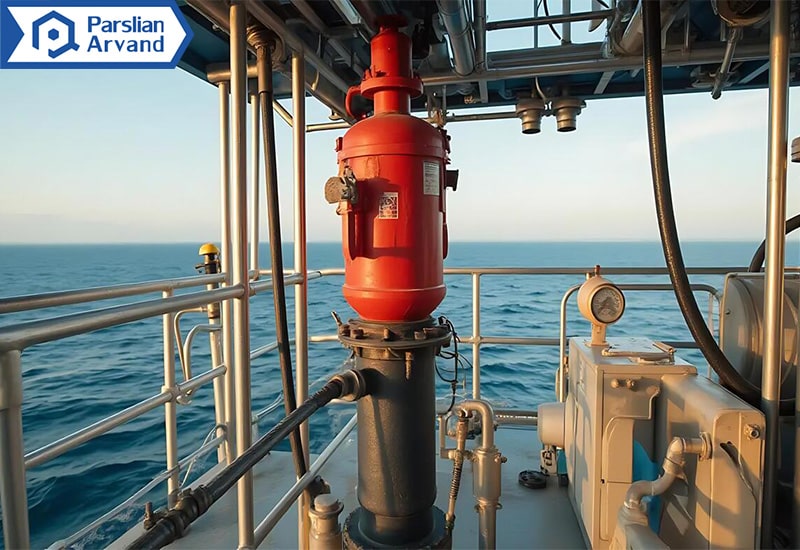
Bunker fuel testing ISO 8217 provides shipowners, bunker suppliers, traders, terminals, and inspection companies with a structured way to assess whether marine fuel meets the quality requirements agreed for delivery and use. The test program can reveal problems involving viscosity, density, sulfur, water, sediment, flash point, catalytic fines, ignition characteristics, and other properties that affect storage, treatment, combustion, regulatory compliance, and machinery reliability. In practice, ISO 8217 Bunker Fuel Testing provides the laboratory framework for making these assessments against the nominated marine fuel grade.
Parsbehin lab provides petroleum product testing, inspection, sampling, and quality control services for commercial and industrial clients. Its petroleum laboratory activities cover fuels, lubricants, light and heavy hydrocarbons, and related petroleum products. For marine clients, bunker fuel quality testing can support cargo acceptance, supplier verification, refinery release, import and export control, and investigation of disputed or abnormal fuel samples.
The most important point is that ISO 8217 is not a single laboratory test. It is a specification that combines general quality requirements with limits for different categories of marine fuel. The correct laboratory program therefore depends on the ordered grade, the edition stated in the bunker contract, and the operational purpose of the results.
What Is the ISO 8217 Fuel Standard?
The ISO 8217 fuel standard defines general requirements and specifications for fuels intended for use in marine diesel engines and boilers before normal onboard treatment such as storage, settling, centrifuging, filtration, and heating.
ISO published the seventh edition, ISO 8217:2024, in May 2024. It covers petroleum derived hydrocarbons as well as permitted synthetic, renewable, recycled, and FAME containing fuels. The current edition defines seven categories of distillate fuels and several categories of residual fuels, including separate groups according to sulfur level and FAME content.
“This document in its entirety defines the general requirements and specifications for fuels used in marine diesel engines and boilers.”
Source: International Organization for Standardization, ISO 8217:2024.
The ISO 8217 fuel standard is therefore intended to describe marine fuel quality at the point of supply before the ship carries out its normal fuel treatment procedures. ISO 8217 Bunker Fuel Testing applies this specification through the appropriate laboratory methods for the fuel category being assessed.
ISO 8217 2017 Fuel Standard for Marine Operations
The ISO 8217 2017 fuel standard for marine applications was the sixth edition of the standard. It specified seven distillate categories and six residual fuel categories. ISO withdrew this edition in May 2024 when ISO 8217:2024 replaced it.
The 2017 edition is still commercially relevant because some bunker contracts may specifically reference it. A laboratory should therefore never assume that the latest edition automatically applies to every transaction.
When a purchase agreement states ISO 8217 2017 fuel standard for marine fuel, the analysis and conformity decision should normally be based on that contractual edition unless the parties agree to change it. ISO 8217 Bunker Fuel Testing must therefore be performed against the edition actually specified in the applicable contract.
CIMAC has published guidance explaining the transition from ISO 8217:2017 to ISO 8217:2024 and the reasons behind the updated requirements.
ISO 8217 Marine Fuel Quality Testing in Practice
ISO 8217 Marine Fuel Quality Testing involves measuring a group of properties that depend on whether the sample is a distillate fuel, a residual fuel, or a fuel containing permitted renewable components.
A typical laboratory program may examine the following:
| Property | What it indicates | Operational relevance |
|---|---|---|
| Viscosity | Resistance to flow | Heating, pumping, purification, and injection |
| Density | Mass per unit volume | Fuel treatment and quantity calculations |
| Flash point | Flammability characteristics | Safety and product conformity |
| Sulfur | Sulfur concentration | MARPOL compliance and contract verification |
| Water | Water contamination | Energy loss, corrosion, and separator load |
| Total sediment | Stability and suspended material | Sludge and filter blockage |
| Aluminum plus silicon | Catalytic fines | Abrasive engine wear |
| Pour point | Low temperature flow behavior | Storage and transfer |
| Acid number | Acidic constituents | Screening for unusual fuel composition |
| Carbon residue | Carbon forming tendency | Combustion and deposit assessment |
| Ignition quality | Combustion behavior | Engine performance |
| FAME content | Renewable ester content where applicable | Grade identification and handling considerations |
The exact limits are grade specific. ISO 8217 Marine Fuel Quality Testing should therefore begin by confirming the fuel designation and applicable edition. For this reason, ISO 8217 Bunker Fuel Testing should always be linked to a clearly identified grade rather than treated as a generic fuel analysis package.
Why Bunker Fuel Quality Testing Matters
The purpose of bunker fuel quality testing is not simply to produce a certificate. The results should help a vessel decide how the fuel can be stored, treated, and consumed.
A fuel can create operational problems even when several headline parameters appear normal. For example, residual fuels with elevated catalytic fines may require careful purifier operation. Poor sediment behavior can lead to sludge and filter problems. High water content increases separator load and reduces useful energy content.
CIMAC has published dedicated guidance on sediment interpretation and onboard fuel cleaning because marine fuel behavior cannot always be understood from one result in isolation.
For practical ship management, laboratory data should be reviewed alongside:
- Fuel treatment system capability
- Engine manufacturer recommendations
- Storage temperature
- Purifier performance
- Existing fuel remaining onboard
- Planned mixing or changeover
- Filter condition
- Previous laboratory reports
Effective ISO 8217 Bunker Fuel Testing gives shipowners a consistent analytical basis for reviewing these operational factors alongside the specification results.
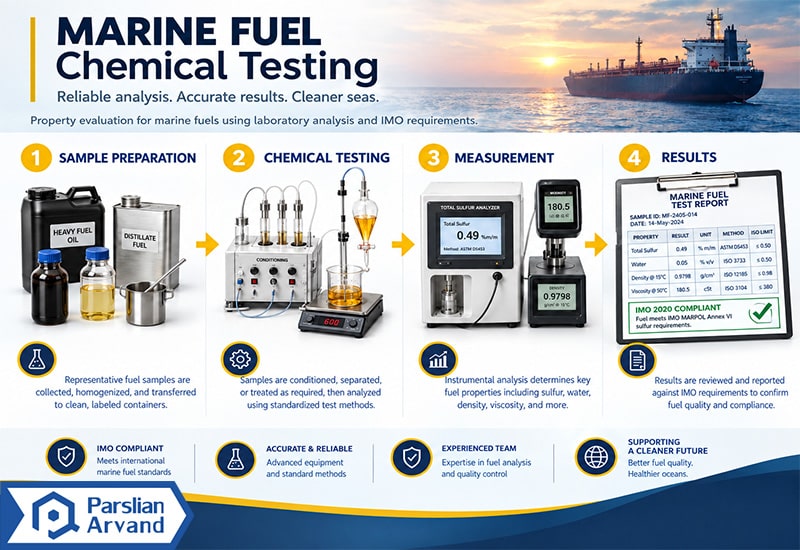
Key ISO 8217 Requirements
The ISO 8217 requirements include both numerical limits and broader quality provisions. This distinction is important.
A fuel should not only meet the table values assigned to its grade. The standard also contains general requirements intended to prevent the supply of material that could jeopardize safety or adversely affect machinery performance.
CIMAC explains that the listed ISO 8217 parameters are designed around technical and operational suitability rather than determining the exact feedstock used to manufacture the fuel. Different petroleum, renewable, synthetic, or recycled feedstocks can produce fuels with similar measurable properties.
The ISO 8217 requirements therefore cannot be reduced to a checklist of sulfur, viscosity, and density. ISO 8217 Bunker Fuel Testing should therefore consider both the numerical limits and the broader quality provisions associated with the specified fuel category.
Important areas include:
- Correct fuel category
- Required physical and chemical properties
- General quality requirements
- Permitted renewable components where applicable
- Appropriate test methods
- Correct sample identification
- Interpretation of results against the nominated edition
Sulfur: ISO 8217 and MARPOL Are Different Frameworks
ISO 8217 and MARPOL Annex VI have related but different purposes.
CIMAC explains that ISO 8217 focuses on the technical and operational requirements of marine fuel, while IMO and MARPOL focus primarily on safety, emissions, pollution, and environmental compliance.
Under MARPOL Annex VI, the general sulfur limit for fuel used or carried for use onboard ships is 0.50 percent by mass outside designated sulfur Emission Control Areas. Within applicable ECAs, the limit is 0.10 percent by mass unless an approved equivalent compliance method is used.
The Mediterranean Sea became a sulfur ECA on May 1, 2025, with the 0.10 percent limit now applying to ships operating in the area.
This is why marine fuel testing must consider both commercial specification and regulatory requirements. A complete ISO 8217 Bunker Fuel Testing program should therefore interpret sulfur results within both the contractual fuel specification and the vessel’s applicable regulatory framework.
Marine Fuel Testing Standards Beyond ISO 8217
ISO 8217 is the central marine fuel specification, but it works together with individual laboratory methods and regulatory procedures.
The broader group of marine fuel testing standards may include ASTM, ISO, IP, and other recognized methods for properties such as:
- Viscosity
- Density
- Flash point
- Sulfur
- Water
- Sediment
- Carbon residue
- Ash
- Metals
- Pour point
- Ignition characteristics
MARPOL also contains separate requirements for fuel oil sulfur verification and sampling. IMO amendments concerning sampling and testing entered into force in 2022 to support enforcement of the 0.50 percent sulfur limit.
The applicable marine fuel testing standards should therefore be identified before the sample is submitted to the laboratory. In ISO 8217 Bunker Fuel Testing, these individual methods provide the measurements used to determine whether the sample meets the relevant ISO 8217 requirements.
Bunker Fuel Specification Testing for Residual Fuels
Bunker fuel specification testing for residual fuels typically focuses on properties that influence storage, purification, combustion, and engine wear.
Viscosity affects heating requirements and injection conditions. Density influences fuel treatment. Total sediment provides information about stability. Aluminum and silicon indicate catalytic fines. Water affects separator operation and usable energy content.
The current ISO 8217 edition also distinguishes multiple residual categories according to sulfur and FAME content. ISO 8217:2024 includes four categories of residual fuels at or below 0.50 percent sulfur, five categories containing FAME, and five categories exceeding 0.50 percent sulfur.
This expanded structure reflects changes in the modern bunker market, particularly the increasing use of renewable blending components. ISO 8217 Bunker Fuel Testing for residual fuels must therefore begin with the correct category before individual test results are evaluated.

What Changed in ISO 8217:2024?
The 2024 revision was more than a routine update.
CIMAC notes that the revision increased the number of specification tables from two to four and created greater flexibility for fuels containing renewable components. Certain grades can now accommodate FAME at concentrations up to 100 percent.
The changes reflect the wider range of marine fuels now entering the market.
For shipowners and bunker buyers, this means that older assumptions based on fossil residual fuel alone are no longer sufficient. The grade designation should be checked carefully before testing and before introducing the fuel into onboard systems.
Sampling Comes Before Testing
Even accurate bunker fuel specification testing can produce commercially weak evidence if the sample is not representative.
A marine fuel sample should be clearly connected to the delivery through appropriate identification, sealing, documentation, and chain of custody. Reliable ISO 8217 Bunker Fuel Testing depends on that connection because even precise laboratory results cannot compensate for a sample that does not represent the delivered fuel.
Before submitting a sample, record:
- Vessel and bunker delivery details
- Fuel grade
- Sampling point
- Date and time
- Seal number
- Sample container identification
- Supplier details
- Requested ISO 8217 edition
- Required laboratory methods
Where a dispute is possible, retained samples should be preserved carefully. The identity of the sample used for contractual testing can become as important as the result itself.
How to Review an ISO 8217 Laboratory Report
When the report arrives, do not look only for the word “pass.”
A useful review sequence is:
- Confirm sample and seal identification.
- Check the fuel grade and ISO edition.
- Compare each result with the correct specification limit.
- Review sulfur against the vessel’s regulatory operating area.
- Examine flash point from a safety perspective.
- Review water, sediment, and catalytic fines for residual fuels.
- Check cold flow properties for distillates where relevant.
- Investigate any unusual result before mixing the fuel with other batches.
A technically complete report should state the method, result, unit, and any relevant conformity information. Reviewing ISO 8217 Bunker Fuel Testing results in this way helps separate routine specification compliance from findings that require operational or commercial attention.
Bunker Fuel Testing ISO 8217 With Parslian Arvand
Parsbehin lab provides petroleum laboratory services for fuels, light and heavy hydrocarbons, lubricants, and related materials. Its services also include inspection and sampling. The company describes a controlled process covering sample receipt, coding, laboratory testing, technical review, and final reporting.
For bunker fuel testing ISO 8217, clients should provide the exact fuel grade, applicable standard edition, required parameters, sample information, and reporting deadline.
The laboratory should also confirm method availability and current accredited scope before testing begins.
Frequently Asked Questions about ISO 8217 Bunker Fuel Testing
What is the current ISO 8217 fuel standard?
ISO 8217:2024 is the current edition. It was published in May 2024 and replaced ISO 8217:2017.
Is ISO 8217:2017 still valid for a bunker contract?
The standard itself has been withdrawn and replaced, but a commercial contract may still specify ISO 8217:2017. In that case, the contractual edition must be considered when evaluating the fuel.
What tests are included in bunker fuel quality testing?
Typical tests include viscosity, density, sulfur, flash point, water, sediment, aluminum plus silicon, pour point, acid number, carbon residue, and ignition related properties.
What are the main ISO 8217 requirements?
The ISO 8217 requirements include grade specific property limits as well as general requirements designed to ensure marine fuels are suitable for their intended technical and operational use.
Is ISO 8217 the same as MARPOL?
No. ISO 8217 defines marine fuel quality specifications. MARPOL regulates environmental issues including sulfur emissions and fuel oil compliance.
Why are marine fuel testing standards important?
Marine fuel testing standards provide standardized procedures so that laboratories, suppliers, shipowners, and inspectors can compare results using recognized methods.
When should a ship request ISO 8217 Marine Fuel Quality Testing?
Testing is commonly requested after bunkering, during supplier verification, before fuel mixing, when abnormal engine symptoms occur, or when a commercial quality dispute develops.
What is the purpose of bunker fuel specification testing?
Bunker fuel specification testing determines whether a representative sample meets the quality limits and general requirements associated with the nominated marine fuel grade and standard edition.