
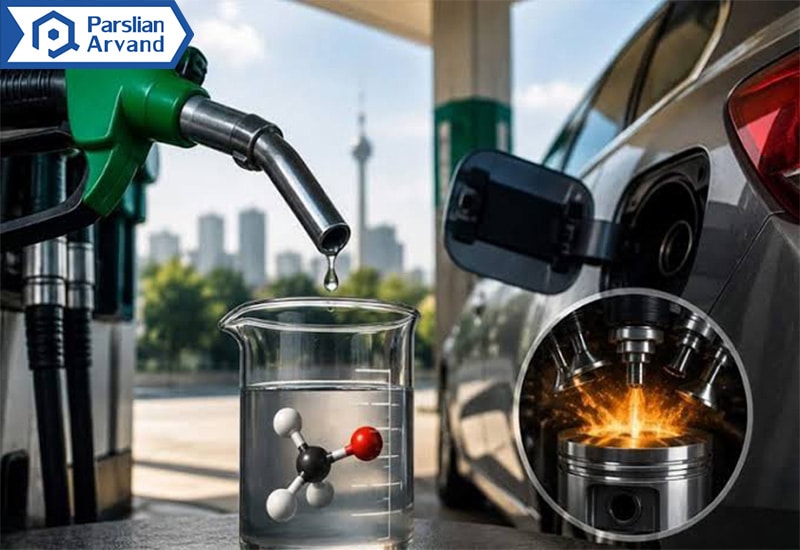
Ethanol in gasoline has become an inseparable part of modern vehicle fuel in many countries. At the gas station, you encounter confusing numbers: E10 on one pump, E15 on another, and perhaps E85. Are these blends merely minor differences in percentage, or does each number conceal realities that can affect engine performance, maintenance costs, and even your vehicle’s durability?
This article explains the differences in E10 vs E15 gasoline, discusses Ethanol in gasoline pros and cons, and answers the questions Is ethanol in gas bad for your car and Does ethanol damage engines? Along the way, Pars Behin Lab, as a specialized reference in fuel quality assessment and analysis of effects on combustion systems, is ready to provide consulting and technical services.
What Is Ethanol in gasoline formula?
Ethanol, or ethyl alcohol, is known by the standard Ethanol in gasoline formula C₂H₅OH (or CH₃CH₂OH); a compound with a molecular weight of 46.07 g/mol obtained by fermentation of plant sugars. Unlike gasoline, which is a complex mixture of C₄ to C₁₂ hydrocarbons, ethanol is a single molecule with a polar hydroxyl group. This hydroxyl group explains ethanol’s different behavior in combustion, moisture absorption, and interaction with engine parts.
Importantly, ethanol blended fuel is never an arbitrary mixture. The ratios E10, E15, and E85 are defined according to specific standards: E10 is 10% ethanol and 90% gasoline; E15 contains 15% ethanol and 85% gasoline; and E85 actually ranges from 51 to 83% ethanol, with the exact ratio depending on season and geographic region. Each blend level creates different requirements for engine materials, fuel delivery systems, and electronic calibration.
Differences between E10, E15, and E85
To understand E10 vs E15 gasoline precisely, a look at technical data is necessary.
| Feature | E10 | E15 | E85 |
| Ethanol percentage | 10% | 15% | 51–83% |
| Vehicle compatibility | All gasoline vehicles after 1980 | Model year 2001 and later | FFV only |
| Octane number (approx.) | 94 | 94–95 | 100–105 |
| Energy content (Btu/gal) | ~112,000 | ~110,000 | ~82,000 |
| Fuel economy reduction | 2–3% | 3–4% | 25–30% |
A gallon of pure ethanol contains only about 76,000 Btu of energy, while regular gasoline produces about 115,400 Btu per gallon. This means Ethanol in gasoline effects on fuel consumption are unavoidable, although their severity increases with higher ethanol percentages.
The effects of ethanol on engines
The effects of ethanol on engines can be examined from several aspects. Ethanol has a much higher octane number than base gasoline. The research octane number (RON) of pure ethanol is about 116, while regular gasoline has 91 to 95 RON. This property makes ethanol blended fuel more resistant to engine knock. Studies have shown that an E22 blend can produce power comparable to pure gasoline while enabling earlier combustion and higher thermal efficiency under full-load conditions.
Real Challenges of Ethanol’s Impact on Engines
But Ethanol in gasoline pros and cons presents a two-sided picture. Ethanol is hygroscopic and can absorb water vapor from the air. At low temperatures, even small amounts of water can form direct hydrogen bonds with ethanol, causing phase separation — that is, gasoline and water split into two separate layers. This phase separation not only destroys fuel quality but can also lead to corrosion of the tank, fuel pump, and injectors.
A study conducted in an experimental engine with a PF90E10 blend showed that continuous use of ethanol-containing fuel can create larger carbon deposits on the surface of the exhaust valve and around it. This finding is consistent with concerns raised in West Virginia state regulations, where ethanol in gasoline is linked to formic acid formation and corrosion of metals, plastics, and rubber.
According to an industrial report by BG Products (2026):
“Increasing ethanol content in gasoline improves fuel combustion and reduces harmful emissions. Ethanol contains more oxygen than regular gasoline; more oxygen means better ignition.”
Does Ethanol Damage Engines?
Is it good to have ethanol in fuel? The answer is not universal. For vehicles manufactured in 2001 and later that are designed for E15 standards, using gasoline containing 15% ethanol is generally safe and can even help reduce carbon monoxide and unburned hydrocarbon emissions. The EPA estimates that E15 is safe for more than 96% of modern passenger vehicles. From an environmental perspective, ethanol as a renewable fuel can reduce greenhouse gas emissions, although a full life-cycle assessment depends on the production source, feedstock, and cultivation method.
Ethanol in gasoline also raises octane and improves combustion, but it has lower energy content than pure gasoline. Therefore, if you are asking Is it good to have ethanol in fuel? we must say it indeed depends on the type of vehicle, its model year, and the manufacturer’s recommendations, or fuel system design. Older vehicles and small engines may not be compatible.
Does ethanol damage engines?
For compatible vehicles, no direct damage has been reported. But in older engines — especially pre-2001 carbureted vehicles and small equipment such as lawn mowers, chainsaws, and boats — the question Is ethanol in gas bad for your car has a different answer. Ethanol in these engines can lead to corrosion of rubber parts, leaks, and disruption of the air-fuel ratio.
A more important point concerns E15: according to the EPA, using E15 in heavy-duty engines such as delivery trucks and school buses is prohibited, because these engines are not designed to tolerate the high oxygen content of E15. Also, vehicles running on gasoline containing more than 10% ethanol may face problems such as hard cold starting, reduced acceleration, and even increased cylinder temperature.
Why Is Ethanol’s Share in Today’s Fuels Growing?
Market data show that ethanol in gasoline is becoming a global standard. According to a Renewable Fuels Association (RFA) report, the ethanol blend rate in the United States exceeded 11% for the first time in October 2025, reaching 11.06%. The 12-month average also set a record of 10.48%. About 95% of gasoline consumed in the United States contains ethanol, and E10 has become the default option at gasoline pumps.
This growth is not accidental. In March 2026, the U.S. Environmental Protection Agency (EPA) issued an emergency waiver allowing nationwide sales of E15 in summer — a period previously restricted due to air pollution concerns. The EPA also eased E10 sales requirements at the national level. These measures were intended to increase fuel supply, lower prices at the pump, and support corn farmers.
However, critics argue that emergency waivers are not a long-term solution. Jeff Cooper, president of the RFA, has called for legislation in Congress to make E15 sales permanent and free from seasonal restrictions.
What Fuel Is Right for Your Vehicle?
Choosing the right fuel requires considering several factors:
- If the manufacturer recommends a minimum octane of 91 and does not allow E15, avoid it
- Vehicles before 2001 may not be compatible with E15.
- In many countries, the ethanol percentage must be displayed on the pump.
- Lawn mowers, chainsaws, and motorboats are among the equipment most vulnerable to the effects of ethanol.
- Moisture absorption and phase separation can reduce fuel quality within a few weeks.
Pars Behin Lab, as a specialized petroleum laboratory, provides fuel quality analysis services and examines the effects of ethanol on combustion systems, helping consumers and industries make more informed decisions about the fuel they use. Accurate laboratory analysis of a fuel sample before use in sensitive engines can help identify potential quality issues and prevent costly repairs.
Conclusion
Ethanol in gasoline is an undeniable reality in today’s fuel market. E10 has become the default standard in many countries, E15 is expanding rapidly, and E85 remains a specialized option for flexible-fuel vehicles. The difference between E10 vs E15 gasoline is not merely five percent ethanol; it lies in engine compatibility, legal requirements, and impact on fuel consumption.
Awareness of Ethanol in gasoline effects — from increased octane and reduced emissions to moisture absorption and phase separation — helps drivers make the right choice. For modern vehicles, ethanol is a component whose properties, when properly understood, allow its benefits to be used while avoiding its limitations.