
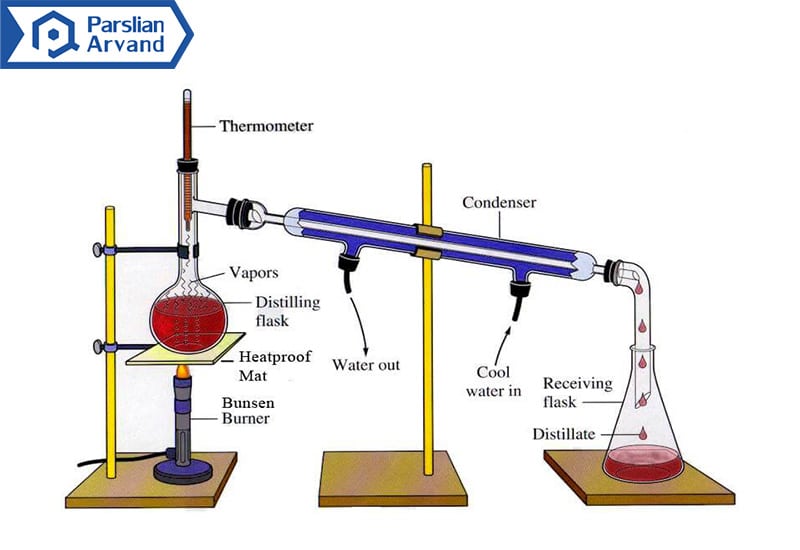
The ASTM D86 distillation test is one of the petroleum industry’s fundamental methods for evaluating how a liquid fuel evaporates across a range of temperatures. Rather than identifying individual hydrocarbons, it shows how much of a petroleum product distills as temperature rises. That information is important for refinery control, product specifications, fuel performance, storage behavior, and commercial quality assessment.
Pars behin lab provides quality control and laboratory services for petroleum products and supports manufacturers, traders, importers, exporters, and industrial clients through specialized testing. For organizations dealing with gasoline, diesel, kerosene, aviation turbine fuel, naphtha, or similar distillates, understanding the ASTM D86 distillation test helps explain why a boiling profile can reveal far more about fuel quality than a single boiling point. Pars behin laboratory operates as a certified partner laboratory of the National Standard Organization of Iran and provides petroleum product quality control within its laboratory network.
In simple terms, the test answers a practical question: how does a fuel evaporate from its lighter components to its heavier ones?
What Is the ASTM D86 Distillation Test?
The ASTM D86 distillation test is a standardized laboratory method for determining the boiling range characteristics of petroleum products and liquid fuels at atmospheric pressure. The current ASTM listing identifies ASTM D86-23ae2 as the active version of the standard.
The method applies to a broad range of light and middle distillates, including:
- Automotive gasoline
- Aviation gasoline
- Aviation turbine fuels
- Diesel fuels
- Kerosene
- Naphtha
- White spirits
- Special petroleum spirits
- Certain marine fuels
- Burner fuels
- Biodiesel blends within the method’s stated scope
ASTM specifically notes that the method is designed for distillate fuels and is not suitable for products containing appreciable quantities of residual material.
This limitation matters. Heavy residual fuel oil and crude petroleum require other methods when atmospheric batch distillation is not technically appropriate.
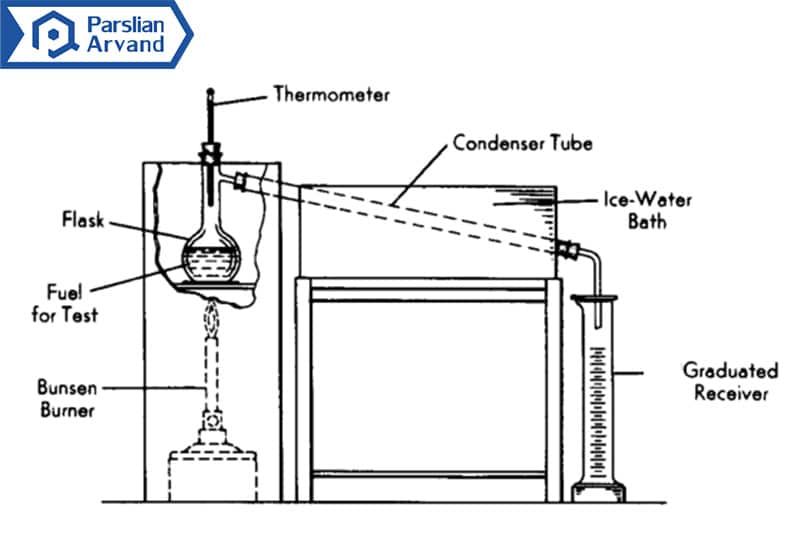
ASTM D86 Atmospheric Distillation Test: The Basic Principle
The ASTM D86 Atmospheric Distillation Test uses a laboratory batch distillation system operated at atmospheric pressure. A controlled sample is heated, vaporized, condensed, and collected while the temperature and recovered volume are monitored.
The purpose is not to separate the fuel into pure chemical compounds. Petroleum fuels contain many hydrocarbons with overlapping boiling temperatures. Instead, the procedure produces a distillation profile showing how the sample behaves as increasingly heavier components evaporate.
ASTM describes the significance of this behavior clearly:
“The boiling range gives information on the composition, the properties, and the behavior of the fuel during storage and use.”
Source: ASTM International, ASTM D86.
The ASTM D86 Atmospheric Distillation Test may be performed using manual or automated equipment. Both approaches fall within the scope of the method when the specified procedure and performance requirements are followed.
What Does ASTM D86 Actually Measure?
The result is a set of temperature and recovery observations rather than one number.
Common reported points include:
| Distillation result | What it represents | Why it may matter |
| Initial Boiling Point, or IBP | Temperature at which the first condensate is observed under the method | Indicates behavior of the lightest portion of the sample |
| 10% recovered | Temperature at which 10% of the sample has been recovered | Useful for assessing early volatility |
| 50% recovered | Midpoint of the distillation curve | Helps characterize the central boiling range |
| 90% recovered | Temperature associated with heavier fractions | Useful for assessing high boiling components |
| Final Boiling Point, or FBP | Highest temperature observed during the final stage of the test, as defined by the method | Characterizes the heavy end of the distillation profile |
| Recovery | Volume collected as condensate | Used in evaluating the overall distillation balance |
| Residue | Material remaining after distillation | Indicates the nondistilled portion under test conditions |
| Loss | Difference not accounted for by recovery and residue | Often associated with highly volatile material and handling |
These values form the distillation curve. Two fuels can have similar density or appearance while showing noticeably different distillation behavior.
This is why the distillation test petroleum products laboratories perform is useful for both production control and independent quality verification.
Why Boiling Range Matters in Fuel Quality
A fuel is a mixture, not a single substance with one boiling point. Its volatility changes throughout the distillation range.
ASTM notes that distillation characteristics influence fuel safety and performance. Volatility affects vapor formation, evaporation, storage behavior, and use. For automotive and aviation gasoline, distillation characteristics can influence starting, warm up, vapor lock tendency, and formation of combustion deposits.
A boiling range test fuel program can therefore provide information about several practical issues:
- Whether the product resembles the expected fuel grade
- Whether light or heavy components appear unusually concentrated
- Whether a refinery blend is consistent from batch to batch
- Whether contamination or cross mixing should be investigated
- Whether the fuel meets contractual distillation limits
The boiling range test fuel results should still be interpreted together with other properties. Distillation alone cannot establish sulfur content, octane quality, cetane number, water content, density, or flash point.
ASTM D86 Explained Through the Distillation Curve
To understand ASTM D86 explained in practical terms, imagine comparing two diesel samples.
Both may look identical and may even have similar densities. During distillation, however, one sample may begin recovering at lower temperatures and show a different 50% or 90% recovery temperature. That difference indicates that the distribution of lighter and heavier hydrocarbons is not the same.
The same principle applies to gasoline, kerosene, jet fuel, and other distillates.
A distillation curve that shifts toward lower temperatures generally indicates a greater contribution from more volatile material. A shift toward higher temperatures indicates a larger contribution from higher boiling components. Interpretation must always be made relative to the product specification and method requirements rather than from the curve alone.
This is the practical meaning of ASTM D86 explained: the method translates a complex hydrocarbon mixture into a measurable volatility profile.
Atmospheric Distillation Fuel Testing in Refinery Operations
Atmospheric distillation fuel testing is widely relevant to refinery process control because refinery streams are continuously separated, converted, treated, and blended.
A refinery may use distillation data to:
- Monitor intermediate streams
- Check gasoline or diesel blending
- Compare production batches
- Investigate an unexpected change in product quality
- Verify finished fuel before release
- Support specification or contract compliance
ASTM states that distillation limits are commonly included in petroleum product specifications, commercial agreements, refinery process control applications, and regulatory requirements.
This explains why atmospheric distillation fuel testing remains valuable even though more advanced analytical techniques are available. It directly measures the physical distillation behavior that many long established fuel specifications are built around.
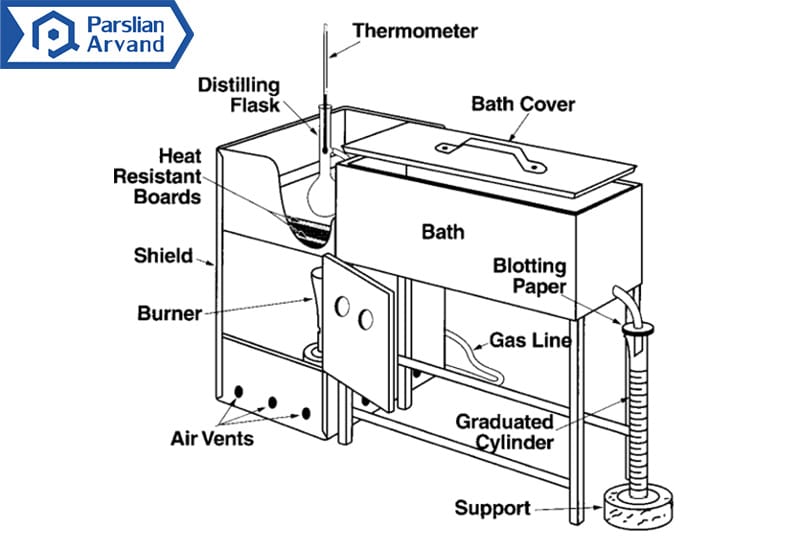
How the Test Is Performed
Although the complete ASTM procedure contains detailed apparatus, conditioning, temperature, and operating requirements, the overall sequence can be understood in a few stages:
- Sample preparation
The appropriate sample is prepared and handled according to the product group and method requirements.
- Distillation setup
The sample is placed in the specified laboratory distillation apparatus and connected to the condenser and receiver.
- Controlled heating
Heat is applied under defined conditions so that the product progressively vaporizes.
- Condensation and recovery
Vapors pass through the condenser and return to the liquid state in the receiving system.
- Temperature and volume observation
Distillation temperatures are associated with defined percentages of recovered sample.
- Final calculations and reporting
Recovery, residue, loss, and relevant boiling points are recorded and reported according to the standard.
The method can be performed with manual or automated instruments, but automation does not change the fundamental measurement principle.
Which Products Are Suitable for ASTM D86?
The distillation test petroleum products scope of ASTM D86 is intentionally broad, but it is not universal.
Suitable products generally include light and middle distillates. ASTM currently lists gasoline, aviation turbine fuels, diesel, kerosene, naphthas, white spirits, selected marine fuels, burner fuels, and other liquid fuels within the method’s scope.
ISO 3405 provides a related atmospheric distillation method for light and middle petroleum distillates with initial boiling points above 0°C and final boiling points below approximately 400°C.
Products containing substantial residual material require a different approach. ASTM’s petroleum standards catalogue lists ASTM D1160 for distillation at reduced pressure, ASTM D2892 for crude petroleum, and chromatographic methods such as ASTM D2887 for determining boiling range distribution by gas chromatography.
ASTM D86 Versus Other Distillation Methods
| Method | General application |
| ASTM D86 | Atmospheric distillation of light and middle petroleum products and liquid fuels |
| ASTM D1160 | Distillation of petroleum products at reduced pressure |
| ASTM D2892 | Distillation of crude petroleum using a laboratory fractionating column |
| ASTM D2887 | Boiling range distribution of petroleum fractions by gas chromatography |
| ISO 3405 | Atmospheric distillation characteristics of light and middle petroleum distillates |
These methods are related but not interchangeable. A contractual requirement for ASTM D86 should not automatically be replaced by simulated distillation or another physical distillation procedure without technical and contractual review.
Why Reliable Laboratory Control Matters
A useful ASTM D86 distillation test depends on correct sample handling, suitable equipment, temperature measurement, operating control, and technical review.
The result may be used to release a refinery batch, compare supplier and receiver samples, investigate fuel contamination, or verify a commercial specification. Small procedural differences can matter when a result is close to a contractual limit.
Parsbehinlab states that its quality control process includes sample receipt and coding, assignment to relevant specialists, technical review of results, and final result delivery. The company also provides inspection, sampling, and specialized laboratory testing services.
For any ASTM D86 request, clients should confirm the current laboratory scope, method availability, required sample quantity, turnaround time, and applicable product specification before submitting the sample.
Frequently Asked Questions about ASTM D86 distillation test
What is the ASTM D86 distillation test used for?
The ASTM D86 distillation test determines the boiling range characteristics of light and middle petroleum products at atmospheric pressure. It is widely used in fuel specifications, refinery control, quality testing, and commercial agreements.
What is measured during an ASTM D86 Atmospheric Distillation Test?
The ASTM D86 Atmospheric Distillation Test records temperatures associated with different stages of sample recovery, together with final recovery, residue, and loss information.
Is ASTM D86 a boiling range test fuel method?
Yes. It is a physical boiling range test fuel method used for many gasoline, diesel, kerosene, aviation fuel, naphtha, and related distillate products.
Can ASTM D86 be used for crude oil?
ASTM D86 is not intended for crude petroleum or materials containing appreciable residual components. ASTM lists other methods, including ASTM D2892, for crude petroleum distillation.
What can abnormal distillation results indicate?
An unusual distillation profile may justify investigation of blending, contamination, product identity, or process consistency. The finding should be assessed together with the applicable specification and other laboratory results.
Why is atmospheric distillation fuel testing still important?
Atmospheric distillation fuel testing directly measures volatility behavior that affects fuel performance and remains incorporated into petroleum specifications, contracts, refinery control programs, and regulatory requirements.
Is automated ASTM D86 testing acceptable?
Yes. ASTM D86 covers both manual and automated instruments when the requirements of the method are met.
What is the ASTM D86 distillation test used for?
If you are asking what is ASTM D86 distillation test, it is a standardized atmospheric distillation method used to determine the boiling range characteristics of petroleum products and liquid fuels.
The ASTM D86 distillation test determines the boiling range characteristics of light and middle petroleum products at atmospheric pressure. It is widely used in fuel specifications, refinery control, quality testing, and commercial agreements.